Hanshantongcheng
The Heart of a DogRejuvenation is the promised outcome that frames Professor Preobrazhensky’s medical practice and the experiment that changes Sharik. The novel first presents it as a question and a source of hope; the later clinical record distinguishes it sharply from what the operation produces, naming the result not renewed youth but total humanization.
The Promise of Rejuvenation
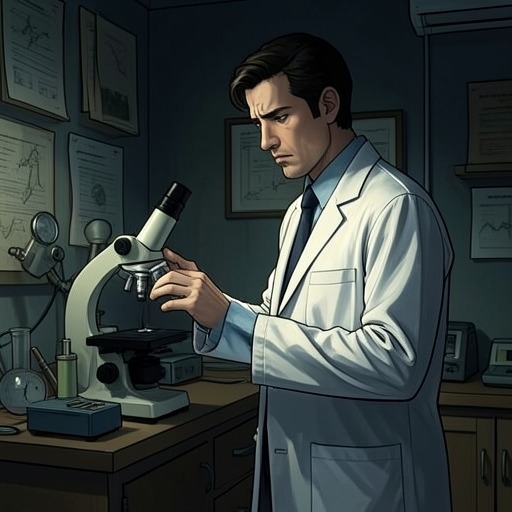
The idea appears early as a question on a large billboard, “Is Rejuvenation Possible?” Its public slogan gives the word an expansive, almost fantastical reach, while the surrounding scene connects it to a recognizable medical promise: an elderly visitor comes to the professor reporting that he has experienced renewed sexual desire after treatment. The visitor describes this change as extraordinary and calls the professor a magician, treating the result as proof of rejuvenation.
Yet the consultation also narrows the promise. The visitor asks whether the professor can rejuvenate his hair, explaining that it has turned grey again and that he is embarrassed to appear at his office. The professor tells him to shave his hair and says that the treatment must proceed one thing at a time. He examines the patient and judges the results to be excellent, but the exchange does not establish that every sign of aging can be reversed. Rejuvenation is thus both the patient’s broad hope and a more limited medical claim, shaped by what the professor believes he can treat.
Medical Practice and Experimental Ambition
The professor’s work is presented through consultations as well as through the later operation on Sharik. One patient is told that monkey ovaries will be implanted in her. The statement shows that the professor’s efforts to alter or restore bodily function extend beyond the specific operation that transforms the dog, although this consultation alone does not specify the outcome or connect it directly to the later experiment.
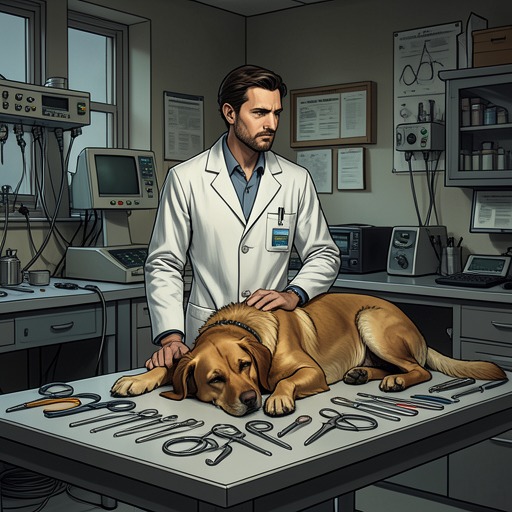
The clinical account of the operation gives the experimental project a precise purpose. On December 23, at 8:05 p.m., Professor Preobrazhensky began what the record calls the first operation of its kind in Europe. Sharik’s testicles were removed and replaced with human testicles and associated structures taken from a man who had died four hours and four minutes earlier. The professor then removed Sharik’s pituitary gland through an operation on the skull and replaced it with the human donor’s pituitary.
The record identifies the aim as studying the combined transplantation of the pituitary and testicles, both to observe whether the transplants would remain functional in a host organism and to examine their role in cellular rejuvenation. Rejuvenation here is not merely a patient’s hope or an advertising phrase: it is a stated scientific question, pursued through a carefully documented experiment. The same record notes that Sharik’s pulse weakened repeatedly during the night and that he appeared close to death, establishing the grave immediate risk without resolving the experiment’s longer-term result at that point.
The Correction: Humanization, Not Renewed Youth
The decisive revision comes in the January 8 entry of the case record. After consultations have become impossible amid a flood of telephone calls, the professor and his colleague finally agree on a diagnosis. The professor acknowledges that his expectation was mistaken: transplantation of the pituitary induces total humanization, not rejuvenation. The distinction is emphatic in the record, where “total humanisation” is underlined three times.
The change is not presented as making the discovery worthless. The entry explicitly maintains that the result does not lessen the value of the professor’s discovery, even as it forces him to correct the purpose and interpretation of the experiment. Rejuvenation and humanization are therefore not interchangeable terms: the procedure produces a transformation, but not the one the stated research question had sought to explain as the effect of the glands on cellular renewal.
The entry immediately follows this diagnosis with observations of the creature’s first walk around the apartment. He laughs after looking at an electric light, moves through the study with the professor and the doctor, and gives the impression of a short, poorly proportioned human male. These observations supply the visible context for the diagnosis, while the case record remains cautious about what they prove: it reports behavior and appearance rather than offering a complete account of the transformation’s causes.
Significance in the Novel
The concept’s force comes from the contrast between its confident public framing and the experiment’s unforeseen outcome. The billboard asks whether rejuvenation is possible; the visitor treats his treatment as a return of youthful capacity; the case record then subjects the same aspiration to clinical correction. What the professor has achieved is described as a major discovery, but its result is humanization rather than a simple reversal of aging.
That difference makes rejuvenation a boundary term in the narrative: it names the expectation that motivates medical inquiry, while the operation exposes how little the expectation can predict about a living organism transformed by transplantation. The dated, procedural entries and the professor’s explicit admission of error prevent the experiment from standing as an uncomplicated triumph. The record preserves both the ambition and its correction, leaving the word “rejuvenation” attached to a promise that the novel’s central experiment does not fulfill as originally conceived.